
“Article 368 amendment of constitution explanation”
Introduction
The Article 368 amendment of constitution explanation helps us understand how changes can be made to the Constitution of India. Article 368 provides the legal procedure that allows the Parliament of India to amend or modify constitutional provisions when required. Since a country’s political, social, and economic conditions change over time, the Constitution must also evolve to remain relevant. Therefore, Article 368 plays a crucial role in maintaining a balance between constitutional stability and flexibility. In this Article 368 amendment of constitution explanation, we will understand the meaning, procedure, importance, and limitations of constitutional amendments in India.
Meaning of Article 368
Article 368 of the Indian Constitution deals with the power of Parliament to amend the Constitution and the procedure for doing so. In simple terms, it provides the rules that must be followed when any amendment to the Constitution is proposed.
The article empowers the Parliament of India to amend the Constitution through a special legislative process. However, this power is not completely unlimited, as it must follow constitutional procedures and respect the basic structure of the Constitution.
Purpose of Article 368
Thea main purpose of Article 368 is to allow the Constitution to evolve with changing times. When the Constitution was adopted in 1950, the framers knew that future generations might need to make modifications.
The objectives of Article 368 include:
- Allowing necessary constitutional changes
- Ensuring legal procedures are followed
- Maintaining constitutional stability
- Protecting democratic principles
This provision ensures that amendments cannot be made casually or without proper debate.
Procedure for Amendment under Article 368
The amendment process under Article 368 follows several steps. These steps ensure that constitutional changes are carefully considered before implementation.
1. Introduction of Amendment Bill
A constitutional amendment bill can be introduced in either house of the Parliament of India — the Lok Sabha or the Rajya Sabha. Unlike ordinary bills, it does not require prior approval from the President before being introduced.
2. Special Majority Approval
The bill must be passed by a special majority, which means:
- A majority of the total membership of the house
- At least two-thirds of the members present and voting
This requirement ensures that constitutional amendments have strong parliamentary support.
3. Approval by Both Houses
Both the Lok Sabha and Rajya Sabha must pass the amendment bill separately with the required majority. If one house rejects the bill, the amendment cannot proceed.
4. Ratification by State Legislatures (in Certain Cases)
Some amendments require approval from at least half of the state legislatures. This usually happens when the amendment affects federal provisions such as:
- Election of the President
- Powers of the states
Distribution of legislative powers between the Centre and the states
5. Presidential Assent
After parliamentary approval, the bill is sent to the President of India. Once the President gives assent, the amendment officially becomes part of the Constitution.

Types of Constitutional Amendments
The Constitution of India allows amendments through different procedures depending on the nature of the change.
Simple Majority
Some provisions can be amended by a simple majority in Parliament. These changes are technically not considered amendments under Article 368.
Special Majority
Most constitutional amendments require a special majority in both houses of Parliament.
Special Majority with State Ratification
Certain amendments require both a special majority in Parliament and approval from at least half of the states.
Judicial Review and Basic Structure Doctrine
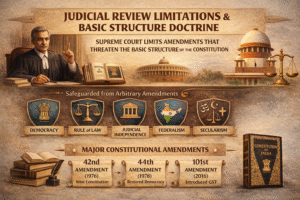
Although Parliament has the power to amend the Constitution, this power is not unlimited. The Supreme Court of India established the Basic Structure Doctrine in the historic Kesavananda Bharati v. State of Kerala.
According to this doctrine, Parliament cannot amend the basic structure of the Constitution. Elements such as democracy, rule of law, judicial independence, and federalism cannot be destroyed through amendments.
This doctrine acts as a safeguard against misuse of amendment powers.
Importance of Article 368
Article 368 plays a crucial role in maintaining the strength and adaptability of the Indian Constitution. Its importance can be understood in the following ways:
- Ensures constitutional flexibility
- Maintains democratic governance
- Provides a structured amendment procedure
- Protects the fundamental framework of the Constitution
Without Article 368, updating constitutional provisions would be extremely difficult.
Examples of Major Constitutional Amendments
Several major amendments have been passed using Article 368. Some of the most significant include:
- 42nd Amendment of the Indian Constitution – Often called the “Mini Constitution” because it introduced major changes.
- 44th Amendment of the Indian Constitution – Restored many democratic provisions after the Emergency period.
- 101st Amendment of the Indian Constitution – Introduced the Goods and Services Tax system in India.
These amendments show how Article 368 has been used to adapt the Constitution to modern governance needs.
Conclusion
The Article 368 Amendment of the Constitution Explanation helps us understand how the Constitution of India can be modified while protecting its fundamental principles. Article 368 gives Parliament the authority to amend the Constitution but also ensures strict procedures and safeguards. Through judicial review and the Basic Structure Doctrine, the Constitution remains protected from arbitrary changes. Therefore, Article 368 plays a vital role in maintaining both the flexibility and stability of India’s constitutional framework.